


Small Acts of Kindness: What a Room Full of Givers Taught Me

On narrow paths, small kindnesses, and the choice we make a hundred times a day
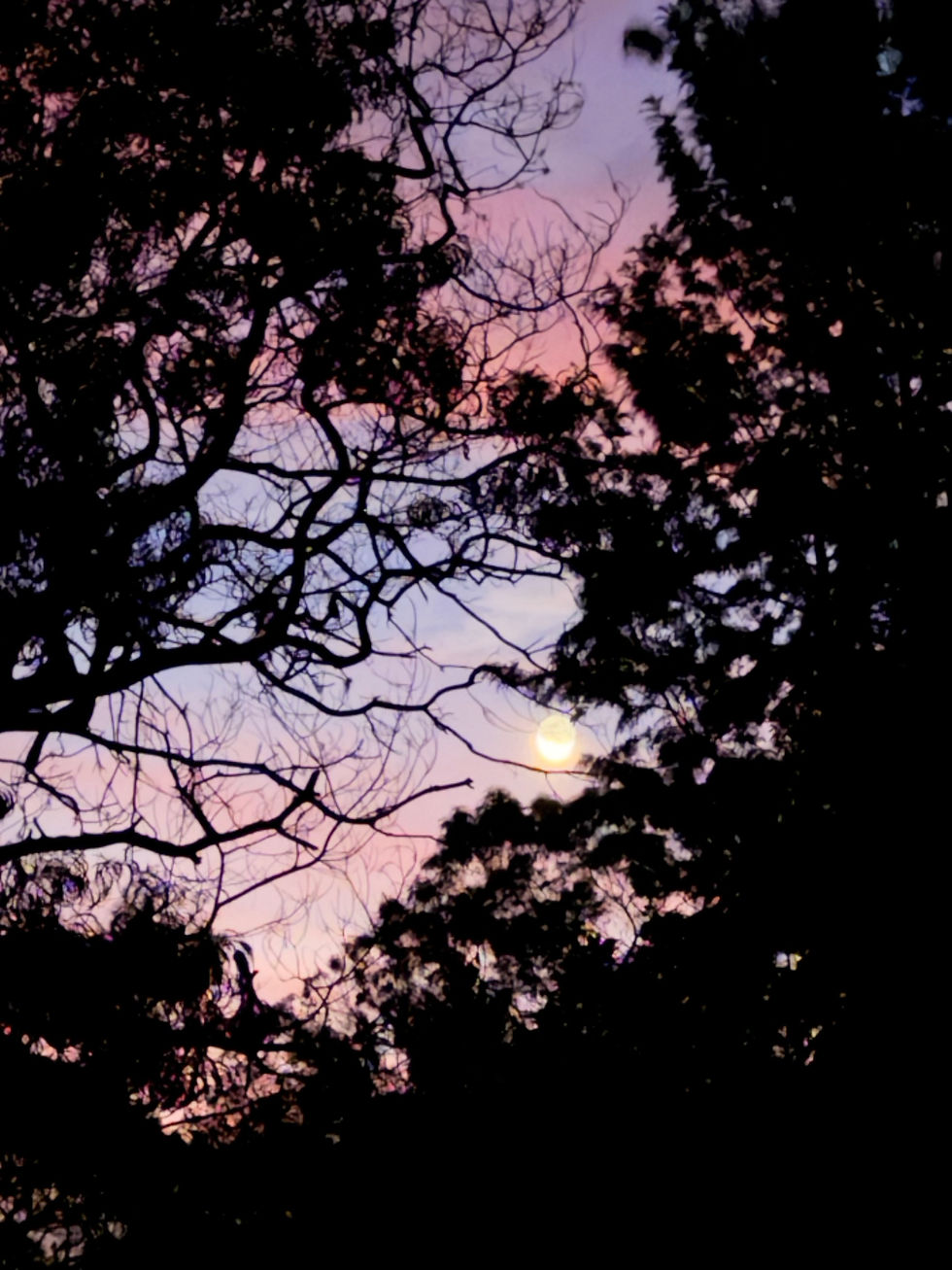
I walked the labyrinth again.
Full moon in Aquarius, Sacred Garden, the kukui trees holding the last of the light.
Before we began, Eve gave her introduction. She has been facilitating these walks for years and she carries the history (or as she likes to call it, the "mystery") of the labyrinth the way some people carry a family story, with a familiarity that makes it feel like it belongs to all of us. And somewhere in what she said, she offered a word I have not stopped thinking about.
She said the walk sometimes helps you find a SOULution.
Not a solution. A SOULution. The answer that arrives from somewhere lower than the thinking mind, in the part of you that has been waiting for you to stop analysing long enough to hear it.
I have written before about what the labyrinth keeps teaching me, about the fear of being on the wrong path and how that fear was never on the ground. That lesson still holds. But last night the path handed me something I had not seen before, and it had nothing to do with me walking alone.
It had to do with everyone else. With the small acts of kindness happening all around me on that narrow path, so subtile and so constant that I almost missed them.
The moment you meet someone on a narrow path.
Here is the thing about walking a labyrinth with a group of people.
The path is one path. It is narrow, made of stones set close together, and it winds back on itself so many times that you are constantly beside someone going the other way. You are walking in while another person is walking out. You round a curve and there they are, a foot away, moving in the opposite direction on the same thin line.
And in that moment, every single time, something has to happen.
One of you steps aside. Or you both do, a small shared adjustment. Or you turn your shoulders. Or you slow down for half a second to let the other pass. It takes almost nothing. A hand's width of space. A breath of hesitation.
It happens so fast that it barely registers as a decision. But it is one.
You can make it easier or you can make it harder.
That was the thought that arrived last night, and it arrived with the force of something obvious that I had somehow never put into words.
On any shared path, you have a choice. You can make it easier for the person coming toward you, or you can make it harder. That is genuinely the whole range. There is no neutral. Holding your line and making someone else navigate around you is also a choice. It just does not feel like one, because it requires nothing from you.
And what struck me most was that nobody in that garden chose harder. Not once.
Every time two people met on that path, both of them moved. There was a kind of soft choreography happening all evening, dozens of small accommodations nobody discussed and nobody was thanked for. People stepping into the side so another person could keep their rhythm. People pausing at a curve so someone else could pass through. All of it happening in near silence, under the moon, while everyone was supposedly deep in their own inner process.
That is what stayed with me. We were all doing our own work. And we were all, at the same time, making room.
It was a room full of givers.
Why small acts of kindness land harder than we think.
Here is where it gets interesting, because there is research on exactly this, and the findings are more surprising than you would expect.
Studies out of the University of Chicago and elsewhere have found that people who perform small acts of kindness consistently and dramatically underestimate how much those acts matter to the person receiving them. Researchers tested this across all sorts of ordinary gestures. Buying someone a coffee. Offering a ride. Giving away a cupcake at a park. In every version of the experiment, the recipient felt significantly better than the giver predicted they would.
The reason is subtle and, I think, quite beautiful. When we give something, our attention goes to the thing. The coffee. The favour. The small object changing hands. We evaluate it by its size and conclude it was not much.
The person receiving it is not experiencing the object at all. They are experiencing the warmth. The fact that someone noticed them. That someone made space.
Researchers also found we overestimate how awkward the other person will feel, which is often the exact reason we hesitate before doing something kind. We talk ourselves out of it by imagining a discomfort that does not arrive.
So the person stepping to the side so I could keep walking my line probably thought nothing of it. And I am writing an article about it days later.
When it spreads.
Adam Grant spent years studying what he calls reciprocity styles, sorting people loosely into givers, takers, and matchers. Givers help without keeping score. Takers extract. Matchers keep a careful ledger and give roughly what they get.
His findings contain a real warning. Givers often land at the bottom of performance measures, because giving without boundaries costs you something real, and some givers give themselves away entirely.
But the top is also full of givers. And Grant noticed something about what happens when a giver succeeds that does not happen with the other two. It spreads. It cascades. A taker who wins produces one winner. A giver who wins produces a pattern, because everyone around them has been shown what is possible and most people, given a live example, will follow it.
I felt this on the path. The first time someone stepped aside for me, something in me softened, and I stepped aside more readily for the next person. Not out of obligation. It just became the water we were all swimming in. One small act had set the temperature for the whole evening.
The same choice, all day long.
What I keep turning over is how often this exact moment shows up once you leave the garden.
The merge on the motorway. The doorway where two people arrive at once. The conversation where someone is fumbling for a word and you can either wait or fill it in for them. The email you could answer in three words or in one. The queue, the lift, the narrow pavement, the shared kitchen.
Every one of them is a labyrinth path. Two people, limited room, a moment of contact, and a choice that takes less than a second and costs almost nothing.
We tend to imagine that our kindness gets expressed in the big gestures. The generous act, the thoughtful gift, the time we showed up when it counted. Those matter. But they are rare, and life is not mostly made of them. Life is mostly made of small acts of kindness, these micro-moments where you either make it easier for someone or you do not.
And here is what the research suggests. Those small moments are landing far harder than we think they are. The person you let merge is not thinking about a car. They are having a small experience of being considered by a stranger on a day you know nothing about.
The SOULution.
I went into that walk with something I have been sitting with, the way I usually do. I was expecting the answer to be about me. About my path, my direction, my next step.
What came instead was about everyone else on the path with me.
Maybe that is what Eve meant. A solution is something the mind works out. A SOULution arrives sideways, usually answering a question you did not know you were asking, and it tends to be simpler and larger than what you went looking for.
Mine came down to something a child could understand. You are on a narrow path with other people. You can make it easier for them or harder. It costs you almost nothing either way.
And underneath that, something else. I have no idea what anyone else on that path was carrying. That is exactly the point. Each person was there for their own reasons, walking their own walk, and I will never know what any of them came to set down. What I know is that whatever they were holding, they still moved aside.
That is the part I want to keep. Not that we should be kind when we have capacity. That the capacity is smaller than we think it needs to be. It fits inside a single step to the left.
Where in your day do you meet people on a narrow path? And what would change if you noticed the choice? I would love to hear.
If this speaks to something in you and you want to explore what it means to walk your own path with more presence, and to make more room, Breathe and Bloom was created for exactly this.
The Sacred Garden of Maliko is in Makawao, Maui. The labyrinths are open to the public, and full-moon walks are led there by Eve Hogan. The Garden is free to walk because someone made it easier. The garden is kept open to everyone, locals and visitors alike, by the Divine Nature Alliance, a small nonprofit that underwrites the entrance so that peace stays available to anyone who needs it. If this story gave you something, consider passing it along. It is one more way of stepping aside on the path.
Further reading:
Eve Hogan — Way of the Winding Path: A Map for the Labyrinth of Life
Adam Grant — Give and Take
Amit Kumar & Nicholas Epley — research on underestimating the impact of prosocial behaviour


Comments